


What are Quantum Technologies and how do they work
Quantum technologies are revolutionising the global technological and industrial landscape. Based on the principles of quantum mechanics, they allow the manipulation of matter at the subatomic level, paving the way for innovations such as quantum computing, quantum communication and quantum sensing.


Quantum computing uses rules of quantum physics that differ from those utilised in traditional computers. In ordinary computers, information is based on bits, which can only be 0 or 1. In the quantum world, however, qubits (quantum bits) are used, which can be 0 and 1 at the same time.
To better understand this concept, imagine tossing a coin into the air. At that moment it is neither heads nor tails, but a combination of both, just like the qubit. Only when the coin lands (that is, when we observe it) does it become heads or tails.
This “combination” is called superposition: the qubit can represent several possibilities simultaneously, and this allows quantum computers to explore many solutions in parallel and solve complex problems much faster, also thanks to two other properties: entanglement and interference.
Entanglement is the ability of two qubits to be so closely connected that, even if they are kilometres apart, what happens to one immediately influences the other. It is as if they were synchronised, regardless of distance.
Interference, on the other hand, helps the quantum computer to strengthen the paths that lead to the right answer and weaken the wrong ones. It is as if the computer tries many solutions simultaneously and then, thanks to interference, manages to bring out the correct one, discarding the others.
In other words: a quantum algorithm, thanks to the effects of superposition and entanglement, can simultaneously explore more than one problem-solving strategy and converge on the most effective one, using interference constructively.
Quantum physics does not apply only to computer science. Besides quantum computing, indeed, there are also:
- Quantum communication, which guarantees inherently secure communications, impossible to intercept, thanks to the application of entanglement.
- Quantum sensing, which enables unprecedented precision measurements in fields such as medicine, geology and navigation.
The context: the main ecosystems
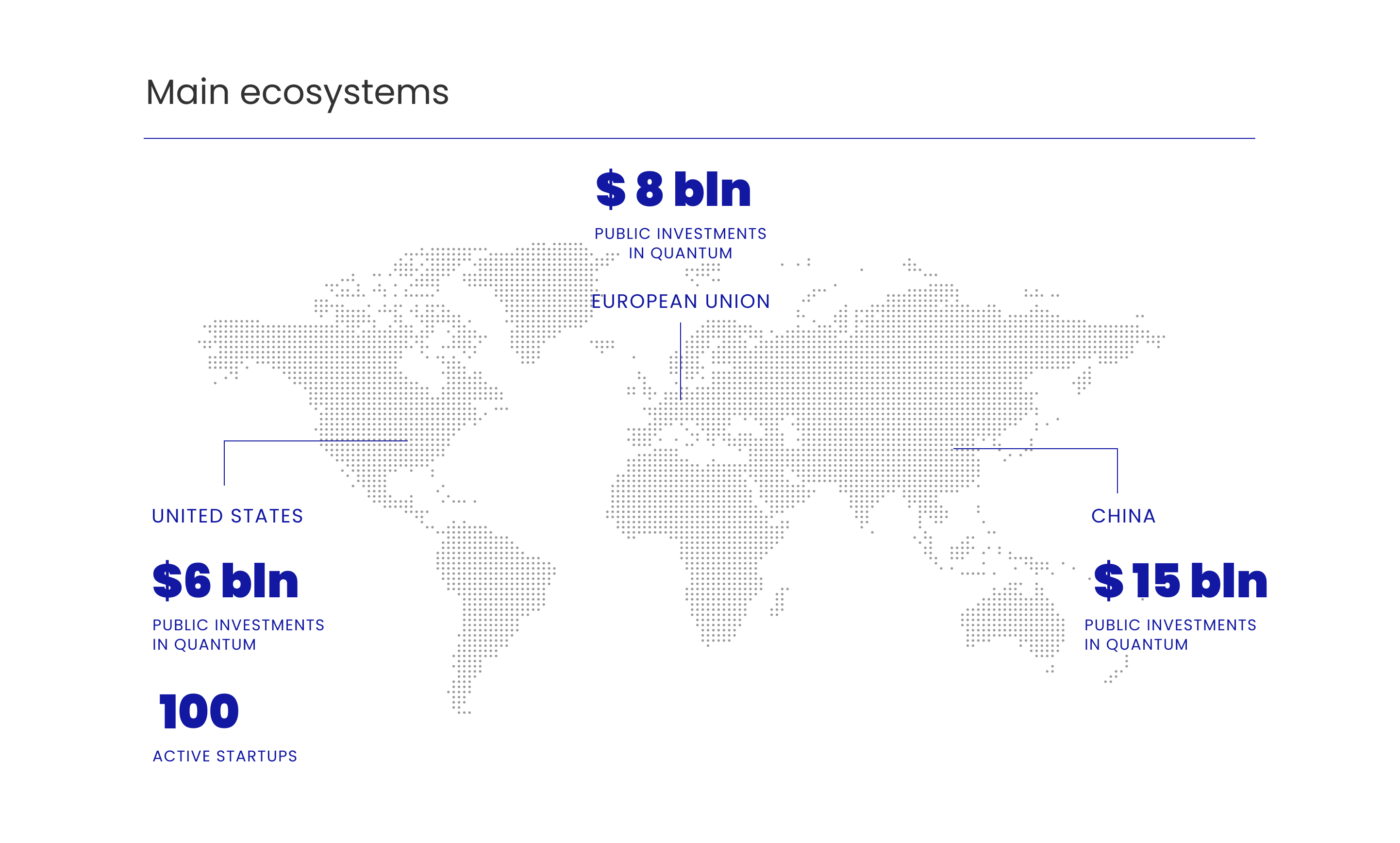
The race for quantum technologies is a global challenge involving the United States, China, the European Union, Japan and other players such as Canada, the United Kingdom, Israel and Australia. It is not a domestic competition: the contest takes place on an international scale, with billion-dollar public and private investments.
- United States: Leader in private investments ($6 billion in public funds and over 50% of global VC investments between 2015 and 2023) and number of startups (over 100 active), with a complete ecosystem ranging from academic research to big tech (IBM, Google, Microsoft, Amazon), deep tech (Atom Computing) and numerous regional clusters. Quantum computing is the most developed segment, with companies like IonQ and Rigetti already listed on the stock exchange.
- China: Leads public investments (over $15 billion) and holds the record for number of patents (32% of global patents) and scientific publications (42% of scientific publications in quantum physics). The approach is centralised and strategic, with a focus on technological sovereignty and dual-use applications (civilian and military).
- European Union: Second for public investments (over $8 billion) with programmes such as Quantum Flagship and EuroQCI. Europe excels in research but struggles to industrialise discoveries. Countries such as Germany, France, the Netherlands, Finland and Italy are particularly active, with national initiatives and cross-border collaborations.
- Other actors: Japan, South Korea, Australia, Israel and Singapore are accelerating with national strategies, targeted investments and international collaborations.
What is happening in Italy
In Italy as well, excellence in research, fuelled by the first public funds allocated by the PNRR, has favoured the emergence of promising startups and university spin-offs, which in the 2023-2024 period raised the first VC funds in the country, totalling 12 million euros¹. However, they are still few compared to other European states, for example one twentieth of those raised by the French in the same period (255 million). In 2024, the first Italian investment fund for quantum technologies was established, marking a significant step towards increasing investments in the country. Italy also registered 1,528 patents in the quantum sector, ranking tenth worldwide.
There are also several Italian companies and startups active in the quantum field, such as Telsy, the company specialising in Cybersecurity and Cryptography of TIM Enterprise, and levelQuantum, an Italian startup that has patented a proprietary solution for an advanced form of QKD.
As for machines exploiting quantum computing, in Naples the superconducting quantum computer with 24 qubits began operating in 2025, funded within the framework of Spoke 10 “Quantum Computing” of ICSC - National Centre for Research in High Performance Computing, marking an important milestone for the Italian scientific community. With its 24 qubits, the quantum version of traditional bits, the new computer represents an advanced starting point to achieve a new type of machine capable in the near future of solving currently impossible problems and demonstrates the rapid growth of the Italian quantum sector.
In May, in Turin, the first IQM quantum computer in Italy was officially switched on. It is one of only 12 IQM systems in the world, a milestone that will position the region at the forefront of quantum technology in Europe, the new frontier of computing.
It is a quantum computer with five qubits, available to the research, industry and academic world, acquired thanks to a partnership between Politecnico di Torino, Fondazione Links and Istituto Nazionale di Ricerca Metrologica. The system was installed in the Politecnico’s data centre and was produced by IQM Quantum Computers, a global leader in the construction of quantum computers.
Conclusion
Quantum technologies are destined to profoundly transform the global economy, with impacts that will extend far beyond the IT sector. The contest is played between major international ecosystems, and success will depend on the ability to overcome technological challenges, train new talents and guarantee sovereignty over critical infrastructures.

WHAT IF...
the discovery of new medicine became instantaneous?


